
The stars: distant suns. This site reflects the culmination of my personal quest to become an astroimager - an amateur astronomer whose avocation is to capture images of the celestial wonders that pass over our heads, largely unnoticed, every day. Thus, this is the triumph of my quest to photograph the distant suns of our Universe - a sun quest.
This journey began with the construction of an observatory in the New Mexico desert, far away from the lights of major towns and huge cities. This resulted in the Bunker Ranch Observatory. There you'll find pictures, descriptions, and accounts of the process of building the observatory, and information on the equipment used to take the images herein.
Your monitor should be adjusted in contrast and brightness so that all 21
grayscale levels below are discernible. You may have to lower the room
lights to succeed at this. (Hint: use the "brightness" control
to change the levels of black, and the "contrast" control
to change the levels of white.)
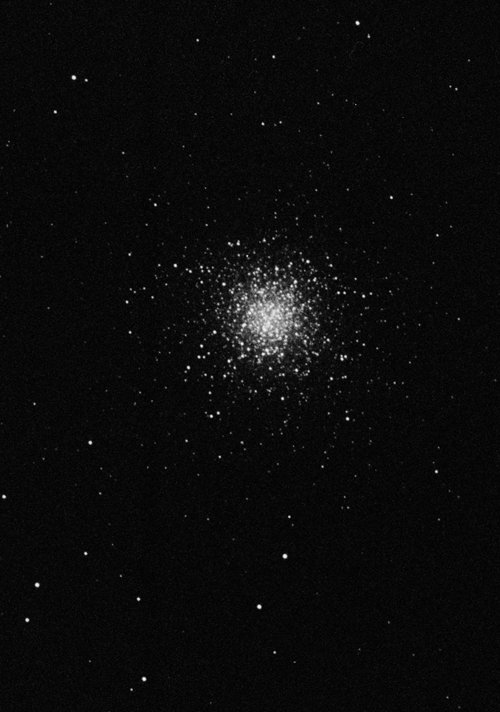
We begin with the first astrophoto taken with the BRO's major instrument, a 400mm (16") Hypergraph. This is M13, the famous globular cluster in Hercules, in a 30-minute exposure with a Pentax 67 camera loaded with Ilford 3200 film. Note the well-known "X" across the center of the cluster.
Globular clusters (so-named for their roughly spherical shape) are very old; they were, in fact, the first large structures to form at the birth of the Milky Way Galaxy about ten billion years ago. There are about 60 of these clusters in a roughly spheroidal pattern co-centered with the galactic disk.
An average globular contains perhaps 100,000 stars; M13 is rather larger
than that, containing several hundred thousand. One estimate even places
the number of stars at over a million.
Below is the first color image taken with the observatory's STL-11000XM CCD camera. This is an LRGB composite of 5-minute images of the Flame and Horsehead Nebulas in Orion. The camera was attached to a Borg 125ED operating at f/4 for a focal length of 500mm.
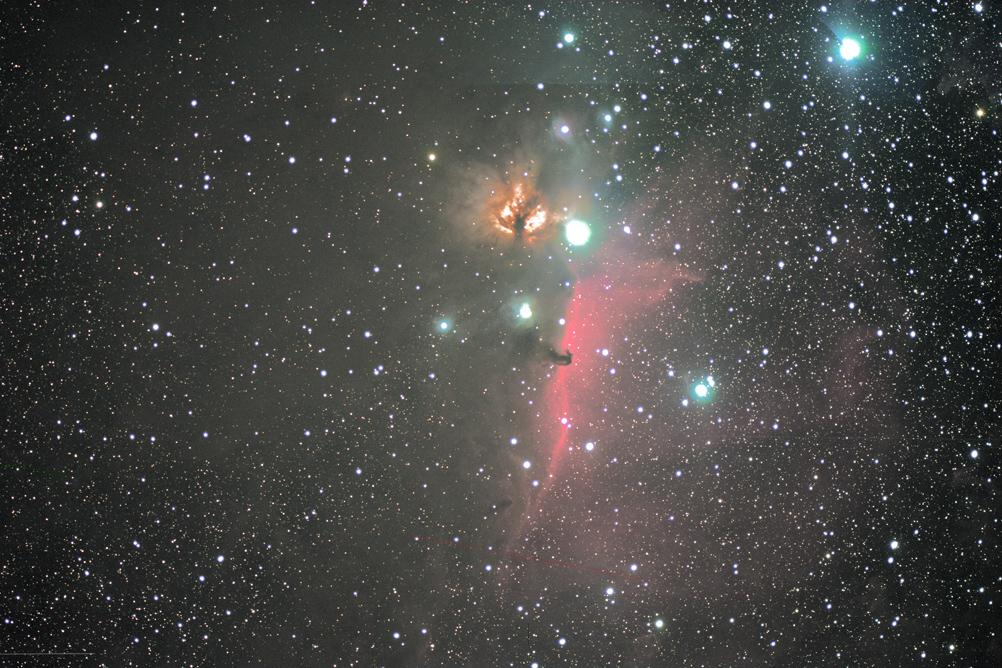
The glowing clouds here shine by fluorescence from the ultraviolet light
emitted by the hot blue stars in the area. The "Horsehead"
visible against the red cloud is a dark dust nebula that is absorbing the
red light from the cloud.
Here is another color image of the same area, taken with the same camera but a different telescope. The telescope used for this image is a Takahashi BRC-250, which is twice the diameter of the Borg 125ED (so it gathers 4 times as much light), but also 3 times the focal length (so the "magnification" is 3 times higher). You'll note that there is more visible detail here; you'll also note that my image-processing skills have improved somewhat over the previous image ...
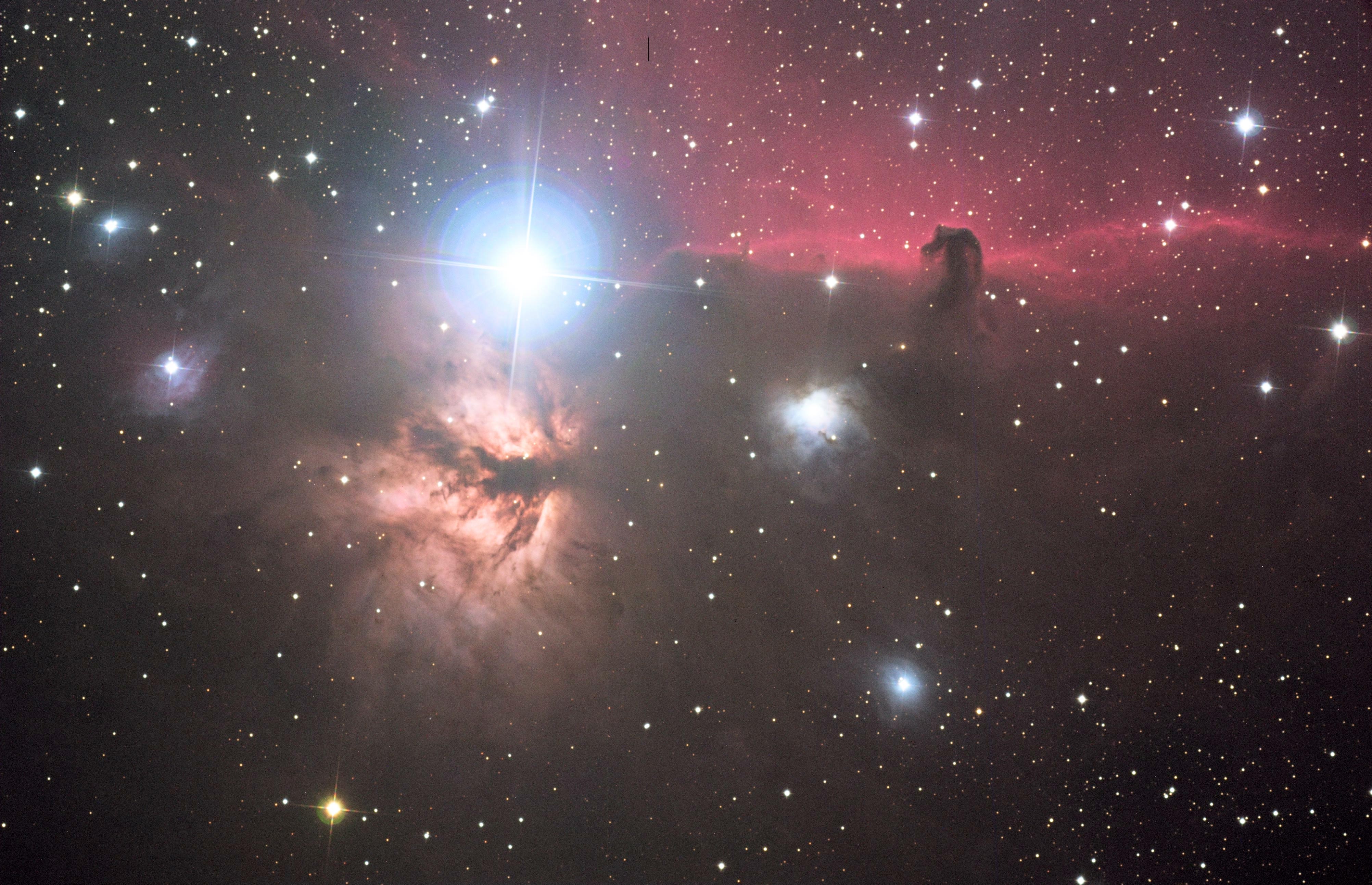
The Bunker Ranch Observatory's blog has an article on
how this image was made.
The yellowish and reddish clouds in this image are huge clouds of hydrogen gas inside the Milky Way Galaxy. The colors are different due to differing overall chemical composition, with the red being more pure hydrogen. These are, of course, far thinner than the water-vapor clouds in Earth's atmosphere that you're used to seeing; the hydrogen clouds contain only a few dozen atoms in the volume of an average-sided room.
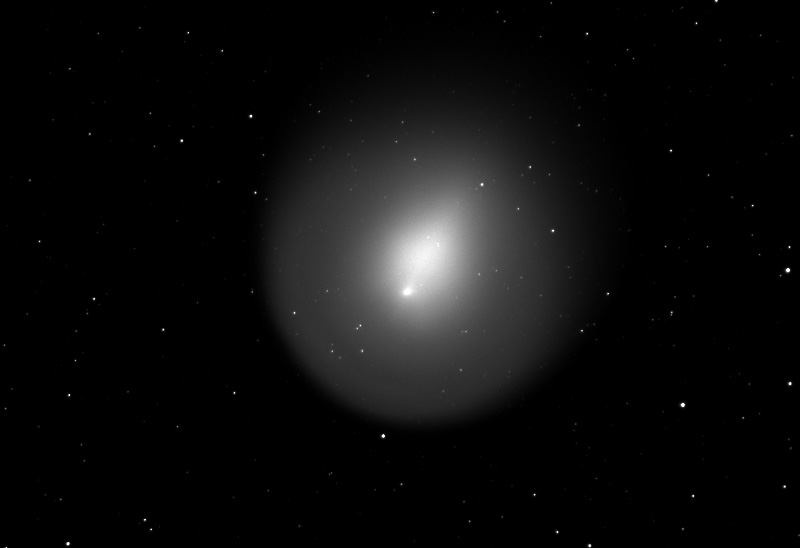
This is an image of Comet Holmes -- a small comet out by the orbit of Jupiter that came to fame with a sudden outburst of gasses that increased its brightness by more than a million times, and made it an easy naked-eye sight in late 2007. This is a short exposure designed to capture details of the comet's nucleus, within the faintly visible halo that was still easily visible as it grew larger than the Sun.
This image was taken with a Borg 125ED configured at 500mm f/4, with an
SBIG STL-11000M CCD camera.
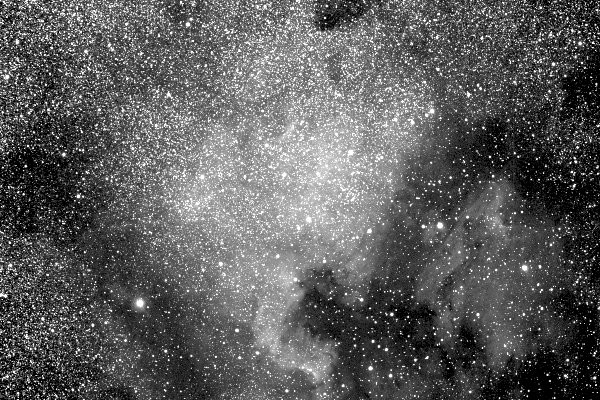
Again taken with the Borg 125ED and the STL CCD camera,
here is a short (one-minute)
exposure of the North America Nebula (NGC7000),
demonstrating that a CCD camera can
capture images with far shorter exposure times than film (with some help
from a bit of digital image processing).
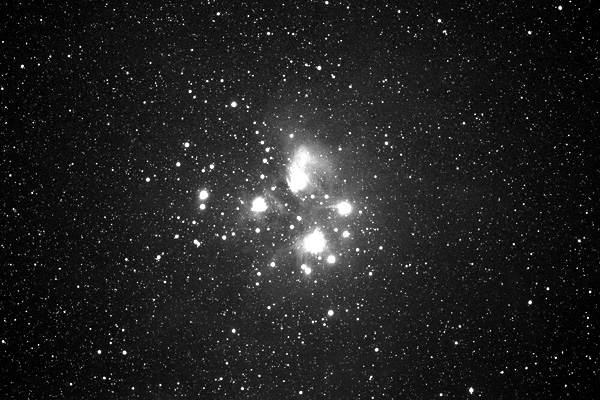
This is another one-minute image from the Borg 125ED and STL CCD camera -
the Pleiades (M45). This is a fairly young association of stars that were
al born together out of the same gas cloud. The haze (blue in color images)
around the stars
is a dust cloud that the stars are passing through, unrelated to the gas
cloud where the stars were born.
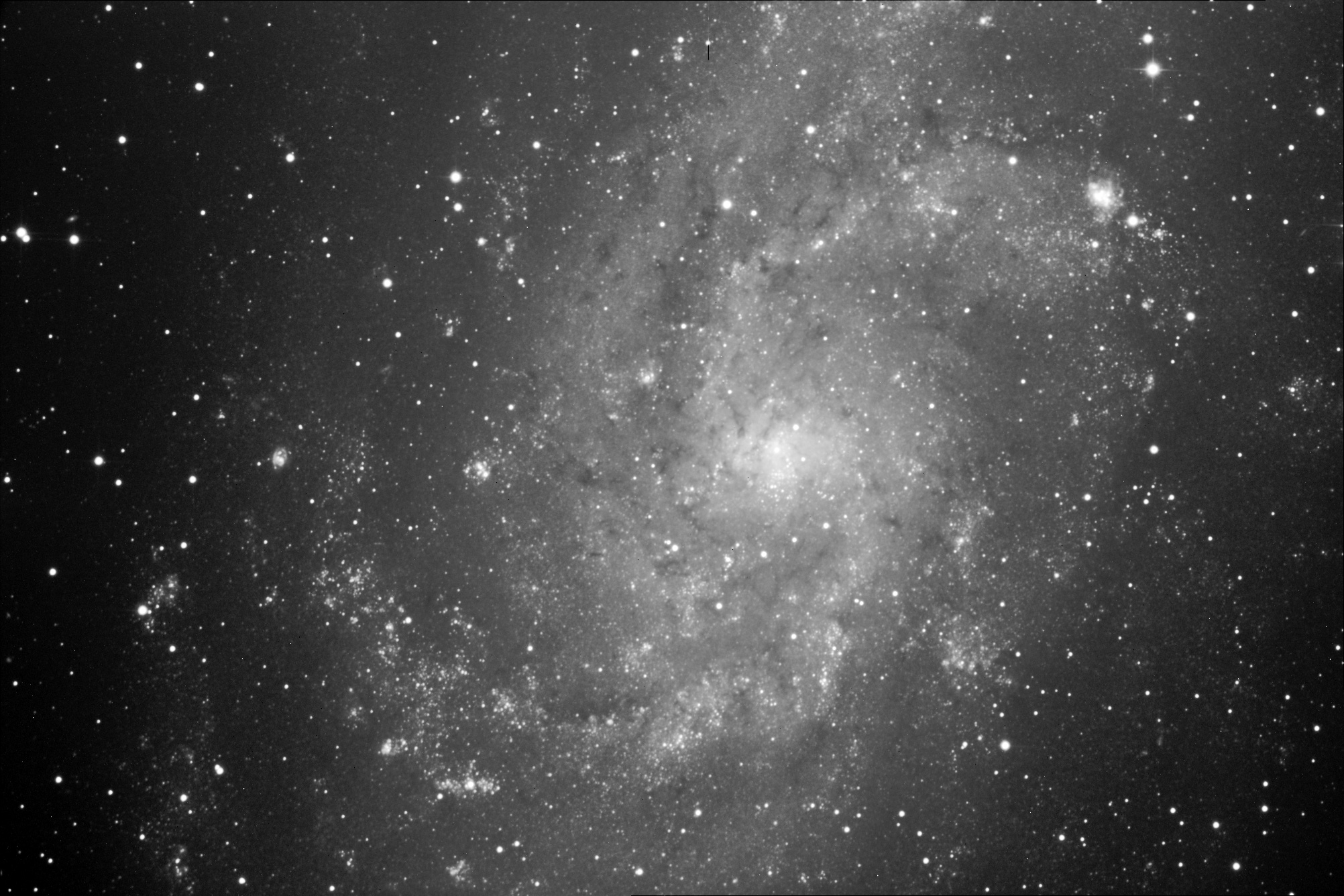
Everything came together one night in November of 2008 -- the sky wasn't the blackest, and the seeing wasn't the steadiest, but the equipment all decided to give me a break and work to perfection for one shining moment. The result was this image of M33, a nearby spiral galaxy.
This is a composite of five 15-minute exposures
taken with the 400mm (16") scope, with some minimal image
enhancement to bring out some of the fainter detail. The full-size
image is large, but, I think, worth a look.
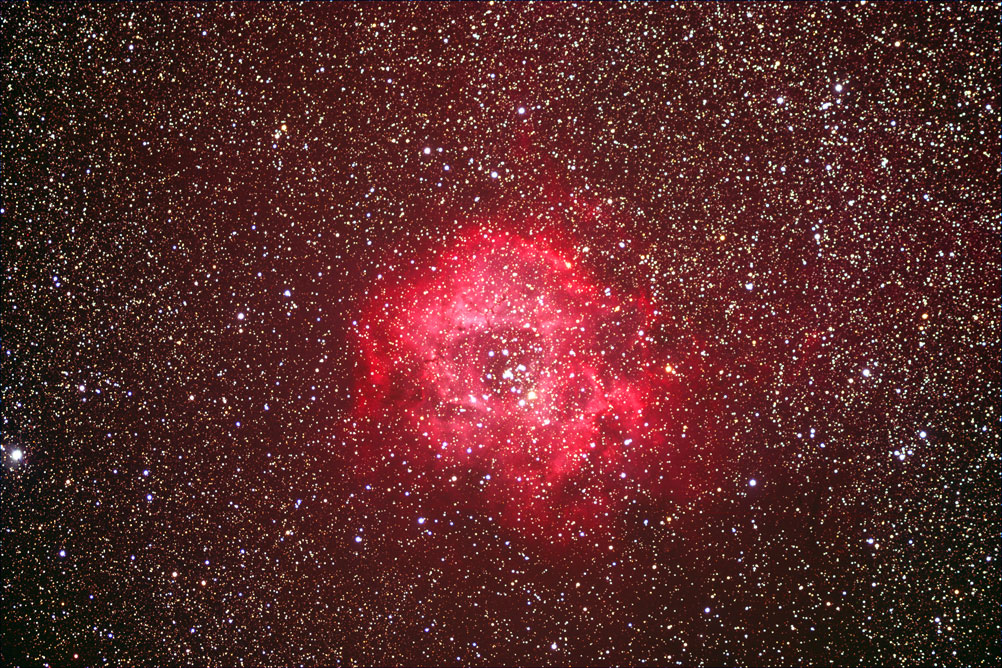
And now for some more color - this is the Borg 125ED and STL CCD camera again; but here we combine four 20-minute images (one each in white, red, green, and blue light), to get a shot of the Rosette Nebula (the nebula is designated NGC 2237; the open cluster of stars inside the nebula is NGC 2244). Note that this image is only 1/4 the size of the original in width and height; that means the original image has 16 times more data than seen here! (Well, actually, it's worse than that, because the original is 16 bits per pixel while this is only 8 bits per pixel. So the original really has 4,096 times the data of this image - 4 times the resolution both horizontally and vertically, and 256 times the color information.)